
The Night the World Went Silent
In the hush of a rain-slicked autumn evening, where the leaves clung desperately to their branches like forgotten promises, Elena stood at the window of her small apartment, gazing out at the world that seemed to have lost its color. The city lights blurred through the veil of her tears, each droplet tracing a path down the glass like the remnants of a love that had slipped away. It was here, in this quiet corner of her life, that the weight of break up sadness first settled upon her soul—a heavy, unyielding fog that enveloped her every thought, every breath.
Elena had met Alex three years ago, under the golden haze of a summer festival. He was a painter, with hands stained in vibrant hues and eyes that sparkled like the sea at dawn. She was a writer, weaving words into tapestries of dreams and desires. Their meeting was serendipitous, a collision of souls amid the whirl of music and laughter. From that day forward, their lives intertwined like vines climbing toward the sun. They shared stolen kisses in hidden cafes, whispered secrets under starlit skies, and built a fortress of memories that felt invincible.
In the early days, love bloomed with the fervor of a wild garden. Alex would paint her portraits, capturing the curve of her smile, the fire in her gaze. Elena would pen stories inspired by him—tales of heroes and heroines who conquered worlds together. They traveled to coastal towns, where the waves crashed against the shore in rhythmic applause for their joy. “You’re my muse,” he’d say, brushing a strand of hair from her face. “And you’re my anchor,” she’d reply, her heart swelling with certainty. But beneath the surface, cracks began to form, invisible at first, like hairline fractures in porcelain.
As months turned to years, the demands of life crept in. Alex’s art career soared, pulling him into galleries and exhibitions far from home. Elena’s writing consumed her, late nights hunched over her laptop, chasing deadlines that never seemed to end. Arguments sprouted like weeds—over missed calls, forgotten anniversaries, the growing distance that neither could bridge. “Why can’t you make time for us?” she’d plead, her voice cracking like thunder. “I’m building our future,” he’d retort, his eyes shadowed with exhaustion. The love that once united them now became a battlefield, littered with unspoken resentments.
Drowning in Break Up Sadness
One fateful night, as the clock ticked past midnight, the storm broke. They sat across from each other in the dim glow of a single lamp, the air thick with tension. “I can’t do this anymore,” Alex said, his words slicing through the silence like a knife. Elena’s heart stuttered, a wild animal trapped in her chest. “What do you mean?” she whispered, though she knew, deep down, the truth that loomed. He looked away, his fingers twisting the hem of his shirt. “We’ve changed, Elena. This isn’t the love we started with. It’s… it’s suffocating us both.”
Tears welled in her eyes, hot and unrelenting. “But we can fix it. We always have.” Her voice trembled, a fragile plea against the inevitable. He shook his head, the finality in his gaze shattering her illusions. “I love you, but I’m not in love with you anymore.” Those words echoed in her mind, a cruel refrain that marked the end. He gathered his things—a sketchbook, a few clothes—and left, the door clicking shut behind him like the closing of a chapter.
In the aftermath, break up sadness descended upon Elena like a relentless tide, pulling her under waves of despair. The apartment, once filled with laughter and shared dreams, now felt like a tomb of echoes. She wandered the rooms, touching objects that held his scent: the mug he favored for morning coffee, the blanket they’d wrapped themselves in during winter storms. Each memory was a dagger, twisting deeper into her wounded heart.
Nights were the worst. Sleep eluded her, replaced by a restless vigil where her mind replayed every moment—their first kiss, the way his laugh lit up a room, the promises they’d etched into the stars. “Why?” she sobbed into her pillow, the fabric soaked with her grief. The break up sadness was not just an emotion; it was a living entity, clawing at her insides, whispering doubts into her ear. “You’re not enough,” it hissed. “You’ll never be loved again.” She curled into a ball, her body wracked with shudders, the pain so acute it felt physical, a vise around her chest that stole her breath.
Days blurred into one another. Elena neglected her writing, the words that once flowed like rivers now dammed by sorrow. Friends called, their voices distant echoes through the phone. “Come out with us,” they’d urge. But she couldn’t summon the strength. Food lost its taste; colors faded to gray. She stared at old photos on her phone, zooming in on Alex’s face, searching for signs of the fracture she hadn’t seen. The break up sadness isolated her, building walls around her heart, convincing her that solitude was her fate.
In the depths of her despair, Elena found herself wandering the streets at dawn, the world awakening while she felt eternally asleep. Rain fell in sheets, mirroring the storm within her. She entered a small park, where benches glistened under the wet sky. Sitting there, soaked and shivering, she allowed the tears to flow freely. Passersby glanced her way, their pity a fleeting shadow, but she was lost in her own tempest. “How do I survive this?” she murmured to the empty air, her voice breaking.
Memories flooded her: the trip to the mountains, where they’d hiked hand in hand, the air crisp and alive with possibility. Alex had proposed a silly game—naming clouds after their future children. Laughter had rung out, pure and untainted. Now, those echoes mocked her. The break up sadness amplified every loss, turning joy into regret. She recalled the fights, the words hurled like weapons: “You’re too clingy,” he’d accused. “You’re never here,” she’d countered. In hindsight, she saw her own flaws—the jealousy that crept in when his art took precedence, the expectations she placed on him like chains.
As weeks turned to months, the break up sadness evolved, no longer a sharp stab but a dull, persistent ache. Elena forced herself to eat, to shower, small victories in a war against oblivion. She journaled her thoughts, pouring the poison onto paper: “Today, the sadness feels like drowning in an ocean of what-ifs.” Writing became her lifeline, a way to externalize the chaos. Yet, the void remained, a gaping wound that time alone couldn’t heal.
One evening, as twilight painted the sky in hues of bruised purple, Elena stumbled upon an old letter from her grandmother, tucked away in a drawer. “In times of sorrow, turn to the Divine,” it read. “Let your tears be prayers.” The words resonated, stirring something long dormant within her. Raised in a family of mixed faiths—her mother a devout Christian, her father a seeker of Islamic wisdom—Elena had drifted from spiritual anchors. But now, in the grip of break up sadness, she yearned for solace beyond the mortal realm.
She lit a candle, its flame flickering like a hesitant hope, and knelt on the floor. “God,” she whispered, unsure of the name—Jesus, Allah, Creator—it mattered not; it was the essence she sought. Tears streamed down her face as she cried louder, her voice rising in a raw, unfiltered lament. “Why this pain? Why now?” The sobs wracked her body, each one a release of the bottled agony. In that vulnerability, she confronted her mistakes—the times she’d been selfish, the moments she’d failed to listen, the love she’d taken for granted.
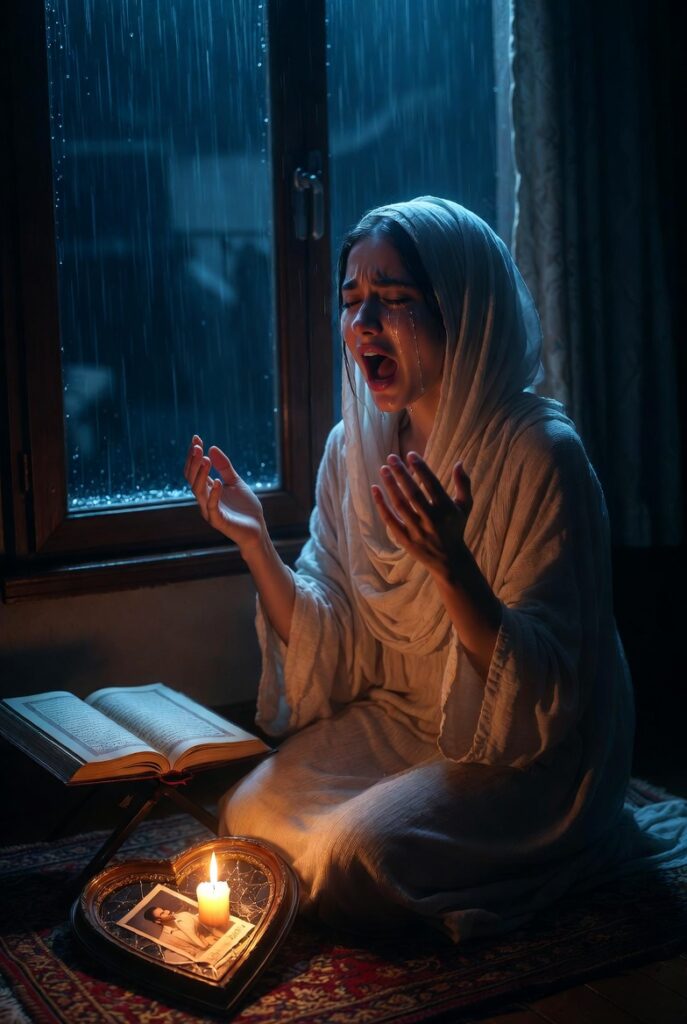
“Help me,” she pleaded, her hands clasped tightly. “Ease this break up sadness that consumes me.” She felt the pain deepen, burrowing into her core, a necessary excavation of the soul. “Don’t let me forget this,” she vowed silently. “Let it shape me, not break me.” The room seemed to hush, as if the universe itself listened. In that sacred space, Elena surrendered, her cries echoing like thunder, washing away the debris of her shattered heart.
As dawn broke, a fragile peace settled. She rose, her eyes swollen but clearer. The path to recovery unfolded like a map in her mind. She reached out to friends, sharing her story over coffee, their empathy a balm. “I’ve been there,” one said, hugging her tightly. Communicating with others bridged the isolation, reminding her she wasn’t alone in her suffering.
To fill the void, Elena immersed herself in hobbies. She dusted off her old guitar, strumming melodies that echoed her emotions. Games became an escape—puzzles that challenged her mind, virtual worlds where she could rebuild without fear. Running in the park, the rhythm of her feet pounding the earth synced with her healing heartbeat. Each activity was a step away from the abyss, a reclaiming of joy.
Yet, the break up sadness lingered, a scar that time would fade but never erase. Elena embraced it, letting it teach her resilience. She volunteered at a local shelter, connecting with strangers whose stories mirrored her own. In their shared vulnerabilities, she found strength. “Pain is a teacher,” she wrote in her journal. “It carves depth into our souls.”
Months later, Elena stood on a hill overlooking the city, the wind whispering secrets of renewal. The break up sadness had transformed her, forging a woman of unyielding spirit. She turned her face to the sky, whispering thanks to her God. “You’ve carried me through the storm.” The motivational fire within her burned bright: To all who wander in the shadows of loss,

remember—return to your Creator, cry out your anguish, reflect on your missteps, seek divine aid in your deepest pain. Feel it profoundly, etch it into your being, for it is the forge of your growth. Then, rise by weaving threads with others, busying your hands and heart in pursuits that ignite your soul. In this dance of sorrow and rebirth, you emerge not broken, but brilliantly whole.
Elena’s journey through break up sadness was not linear; it twisted like a river carving through stone. In the immediate days following the breakup, she isolated herself further, deleting social media apps to avoid glimpses of Alex’s life without her. But solitude bred monsters—doubts that multiplied in the quiet. One night, plagued by insomnia, she ventured out to a bookstore, seeking refuge in pages that promised escape.
There, amid shelves groaning with tales of love and loss, she picked up a novel about a woman reclaiming her life after heartbreak. The protagonist’s words leaped off the page: “Sadness is the soil from which new love grows.” Inspired, Elena began writing her own story, channeling the break up sadness into prose. Her fingers flew across the keys, describing the ache as “a symphony of shattered dreams, each note a tear unshed.”
As she delved deeper, memories resurfaced in vivid detail. Their first date: a picnic under cherry blossoms, petals falling like confetti. Alex had fed her strawberries, his laughter warm as sunlight. The break up sadness tainted it now, turning sweetness bitter. She wrote of the signs she’d ignored—the late nights he spent at the studio, the growing silence between them.
Friends noticed her withdrawal and intervened. Maria, her closest confidante, dragged her to a yoga class. “Breathe through the pain,” the instructor intoned. Elena tried, her body contorting into poses that mirrored her inner turmoil. Afterward, over tea, Maria shared her own breakup tale. “It feels like the end, but it’s a beginning.” Their conversation flowed like a healing stream, Elena opening up about her regrets—the arguments where pride won over compassion.
Encouraged, Elena sought spiritual guidance. She visited a church, the stained glass windows casting rainbows on the pews. Kneeling before the altar, she prayed to Jesus, her mother’s faith guiding her. “Forgive my mistakes,” she whispered, tears flowing. The pain intensified, a cathartic release. Later, she explored a mosque, drawn to her father’s roots. In prostration, she called upon Allah, her cries louder, echoing in the sacred space. “Grant me strength in this break up sadness.”
The Creator, in whatever form, became her anchor. She meditated daily, reflecting on flaws: her insecurity that pushed him away, her failure to communicate needs. “Help me grow from this,” she begged. The pain she felt deeply became a companion, not an enemy—a reminder to cherish future loves.
Recovery blossomed through action. She joined a book club, conversing with kindred spirits. Laughter returned, tentative at first. Hobbies reignited passion: painting classes where she smeared canvases with emotions, video games that transported her to fantastical realms. “Busy your mind,” she advised herself, “and the heart follows.”
One year on, Elena published a novel inspired by her ordeal, titled “Echoes of Shattered Hearts.” It chronicled break up sadness with raw honesty, ending on a note of hope. Readers wrote letters: “Your story saved me.” In motivational fervor, she spoke at events: “Embrace the sorrow, cry to your God—Jesus, Allah, the Creator. Feel the pain eternally as your teacher. Connect with others, lose yourself in hobbies. From ashes, you rise phoenix-like.”
Her life rebuilt, Elena dated again, wiser, more open. The break up sadness was a chapter closed, but its lessons eternal. In the novel’s language of her soul, she found redemption.
Flashback: Their anniversary trip to Paris. The Eiffel Tower glittered like a diamond crown. Alex proposed a toast: “To us, forever.” Elena’s heart soared. But even then, hints of discord—his phone buzzing with work emails, her irritation bubbling.
Back to present: Elena visited the beach they loved, waves crashing like her emotions. She screamed into the wind, releasing rage. The break up sadness peaked, then ebbed.
She volunteered at a crisis hotline, listening to others’ pains, her empathy deepened by experience. “Talk to people,” she realized, “it heals.”
Hobbies expanded: gardening, planting seeds as metaphors for growth. Games like chess taught strategy in life.
Spiritual practice deepened: Daily prayers, journaling mistakes, seeking forgiveness. “Don’t forget the pain,” she vowed, “it keeps you humble.”
Motivational end: In the tapestry of life, break up sadness is a dark thread that weaves strength. Return to your God, cry your soul’s lament, ponder errors, implore aid. Feel the depths, carry the scar proudly. Reconnect with humanity, immerse in passions—games, hobbies that spark joy. You are not defeated; you are reborn, a testament to resilience’s glory.
Used the New88link to get through and it worked like a charm. No hitches, straight to the good stuff. If you need a reliable way to access, this is it. Find it here new88link