

Introduction
In the dimly lit halls of the Egyptian Museum in Cairo, two figures sit eternally poised, their eyes piercing through millennia with an almost supernatural realism. These are the painted limestone statues of Prince Rahotep and his wife, Princess Nofret, masterpieces from Ancient artz Egypt’s Old Kingdom. Dating back to the 4th Dynasty, around 2575-2551 BCE, these sculptures capture not just the likeness of a royal couple but the essence of an era’s artistic prowess. Discovered in 1871, they have fascinated historians,
archaeologists, and art enthusiasts alike for their lifelike quality and the window they offer into the lives of Egypt’s elite. In this blog post, we’ll delve into who Rahotep and Nofret were, their contributions to ancient society, the dramatic story of their statues’ discovery, and the intricate artwork that makes them icons of ancient art.

The statues stand as testaments to the sophistication of ancient Egyptian craftsmanship, blending religious symbolism with portraiture. At approximately 120 cm tall each, they depict the couple seated on thrones, gazing forward as if ready to engage with the afterlife. Their preservation is remarkable, with original colors still vivid after over 4,500 years. As we explore these artifacts, we’ll highlight how they embody the principles of ancient artz – a term evoking the timeless techniques and cultural depth of Egypt’s sculptural traditions.
Who Were Rahotep and Nofret?
Rahotep was a prominent prince in ancient Egypt, born as the son of Pharaoh Sneferu, the founder of the 4th Dynasty and builder of the Meidum Pyramid. Sneferu, known for his ambitious pyramid projects, reigned around 2613-2589 BCE, and Rahotep likely lived during this time and possibly into the reign of his half-brother Khufu, the architect of the Great Pyramid at Giza. As a member of the royal family, Rahotep held the title “the son of the king, begotten of his body,” underscoring his direct lineage and high status.
His wife, Nofret (whose name means “beautiful one”), was a princess and noblewoman, titled “King’s Acquaintance.” This honorific suggested close ties to the pharaoh, possibly indicating she was of royal blood or held significant influence at court. Together, they had six children: three sons named Djedi, Itu, and Neferkau, and three daughters – Mereret, Nedjemib, and Sethtet. All their offspring bore the title “King’s Acquaintance,” reflecting the family’s elevated position. The couple was buried in mastaba 6 at Meidum, a flat-roofed tomb structure typical of the period, located near Sneferu’s pyramid. This burial site, with separate chambers for each, highlights the gender-specific rituals in ancient Egyptian funerary practices.
Rahotep and Nofret’s family life is glimpsed through tomb illustrations, showing them with their children at offering tables. These depictions not only humanize them but also emphasize the importance of family in ensuring continuity in the afterlife, a core belief in ancient Egyptian culture.
Their Roles and Achievements in Ancient Egypt
Rahotep was no mere royal figurehead; he was a multifaceted leader with titles that spanned religious, military, and administrative domains. As High Priest of Ra at Heliopolis – the center of sun god worship – he bore the unique honorific “Unique to Heliopolis, Ra’s town of Greatest of Seers.” This role placed him at the heart of Egypt’s spiritual life, overseeing rituals that linked the pharaoh’s divine kingship to the sun god. Additionally, he served as Director of Expeditions, Supervisor of Works, and Chief of the Builders, roles crucial during an era of monumental construction. His involvement in pyramid building logistics, including material transport via the Nile, contributed to the architectural feats of his father’s reign.
He also held military titles like Chief of the Royal Army, suggesting he may have led campaigns or maintained order. Rahotep’s administrative prowess extended to provincial governance, where he supervised construction projects that supported artisan communities. His early death – inferred from the tomb’s completion during Sneferu’s time – did not diminish his legacy; instead, it preserved his image as a young, vigorous prince.
Nofret, while less documented in titles, played a vital role as a consort and mother in the royal household. Her title “King’s Acquaintance” implied advisory or ceremonial duties, and her depiction in the tomb with an enigmatic additional title *miteret* hints at specialized functions, though its meaning remains obscure. Together, the couple exemplified the ideal of partnership in ancient Egyptian society, where spouses supported each other in worldly and eternal pursuits. Their achievements, though not as grand as pharaohs’, were integral to the stability and cultural flourishing of the Old Kingdom.
The Discovery of the Statues
The statues’ unearthing in 1871 remains one of archaeology’s most thrilling tales. French archaeologist Auguste Mariette, excavating the Meidum necropolis near the mastaba of Rahotep’s brother Nefermaat, directed workers under Albert Daninos to clear a stele. This revealed a shaft leading to mastaba 6. A worker descended with a candle and recoiled in terror, convinced he had encountered living beings. The flickering light had animated the statues’ inlaid eyes, making Rahotep and Nofret appear alive after centuries in darkness.
Mariette’s team carefully extracted the paired sculptures from a sealed chamber, designed to house the ka (life force) if the mummies were disturbed. The find was sensational, as the statues were remarkably intact, with polychrome paints preserving their original vibrancy. Further studies by Flinders Petrie in 1892 detailed the tomb’s frescoes and inscriptions, enriching our understanding. Initially housed in the Bulaq Museum, they now reside in Cairo’s Egyptian Museum, where they continue to captivate visitors with their hypnotic gaze.
This discovery underscored the advanced preservation techniques of ancient Egyptians and sparked global interest in Old Kingdom artifacts, influencing modern perceptions of Egypt’s golden age.
The Masterpiece of Ancient Artz : Description and Features
At the core of these statues’ allure is their embodiment of ancient artz – the refined, symbolic craftsmanship that defined Egyptian sculpture. Crafted from stuccoed limestone, the figures are seated on white thrones, each with hieroglyphic inscriptions listing names and titles. Rahotep, on the left, has reddish-brown skin (a convention for males denoting vitality), a short white skirt, and a neat mustache – a rare feature emphasizing his maturity. He clutches a staff in his left hand, his right flexed on his chest, exuding authority.
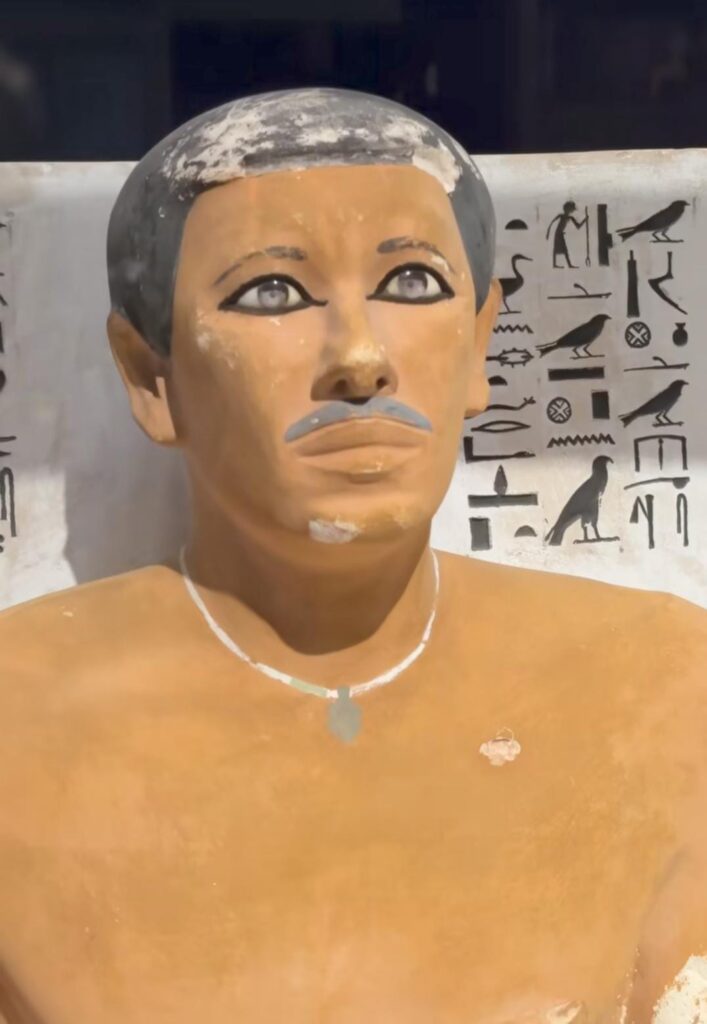
Nofret, beside him, features pale yellow skin (symbolizing feminine indoor life), a tight white sundress with a cape, and a short wig adorned with a floral diadem. Her wide necklace and kohl-lined eyes highlight her beauty, with natural hair peeking beneath the wig for added realism. Both have inlaid eyes of white quartz and rock crystal, creating a lifelike sparkle that startled discoverers. The polychromy – reds, blacks, whites, and blues – adheres to canonical proportions, blending idealism with portraiture.
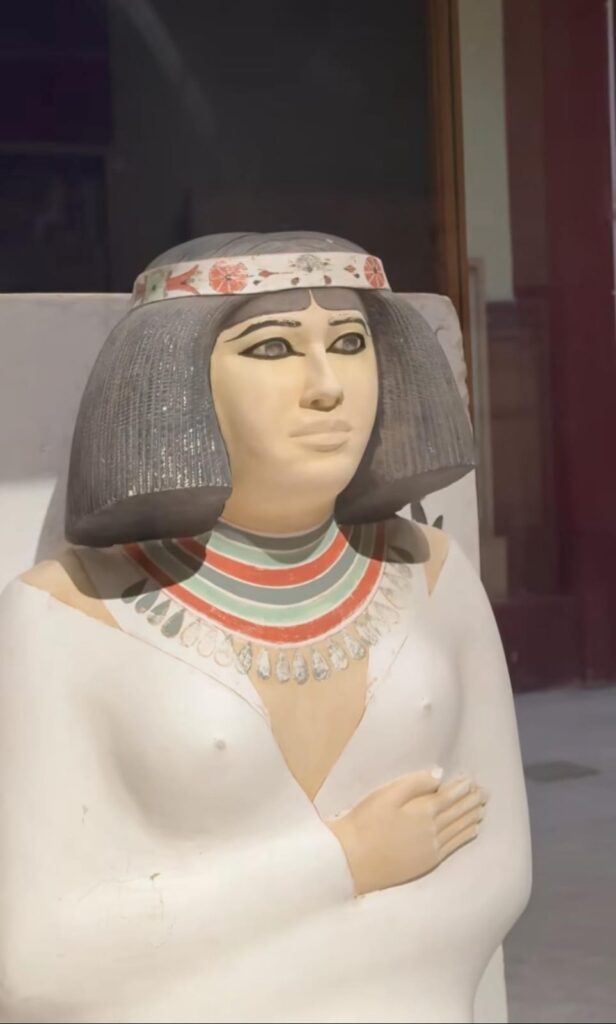
Artistic details like barefoot poses on footstools and symmetrical compositions reflect eternal stability. These elements showcase ancient artz’s fusion of functionality (for the afterlife) and aesthetics, making the statues not just representations but magical conduits for the soul.
Symbolism and Significance in Egyptian Ancient Artz
In the broader tapestry of ancient artz, Rahotep and Nofret’s statues symbolize the Old Kingdom’s artistic zenith. They adhere to the canon of proportions, where figures are idealized yet individualized – Rahotep’s mustache and Nofret’s blue eyes add personal touches amid rigid conventions. The dual statues emphasize marital unity, crucial for afterlife harmony, and their placement in the mastaba served a ritual purpose: to sustain the ka if bodies decayed.
Their significance lies in illustrating social hierarchies, gender roles, and religious beliefs. Male dominance is subtly conveyed through Rahotep’s darker tone and staff, while Nofret’s adornments celebrate femininity. As artifacts from a transitional period in pyramid evolution, they bridge early dynastic styles with later grandeur, influencing subsequent art. Today, they stand as benchmarks for realism in ancient sculpture, inspiring debates on Egyptian influences on global art history.
Conclusion
The statues of Rahotep and Nofret transcend mere stone; they are portals to a world where art, religion, and royalty intertwined. From their royal lineage and administrative feats to the spine-tingling discovery and exquisite craftsmanship, these figures encapsulate the enduring magic of ancient artz. As we gaze upon them in 2025, they remind us of humanity’s quest for immortality through creation. Visiting the Egyptian Museum or studying replicas offers a chance to connect with this legacy – a couple frozen in time, yet forever alive in our imagination.
If you’re looking to try your Luck, you got to give luckypkr777 a shot. I’ve had some decent wins there, just saying. Maybe you will too? luckypkr777
mrf2j4